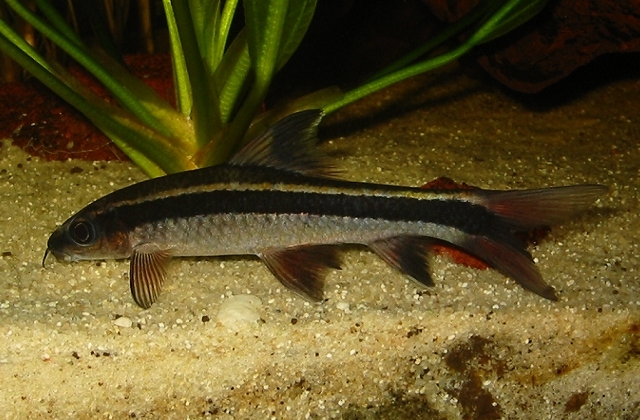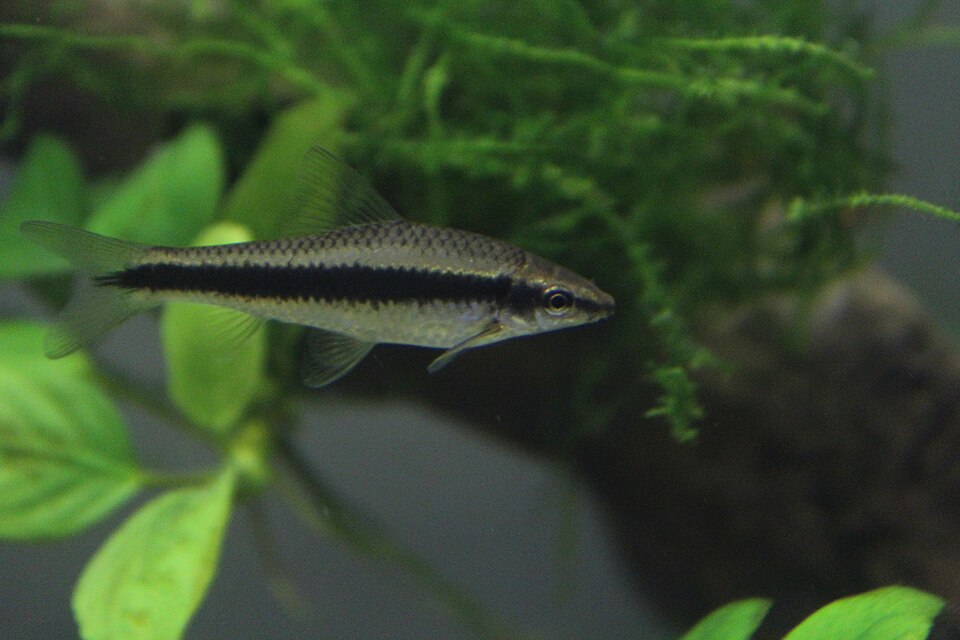
Candidate
Siamese algae eater
Crossocheilus oblongus
Open full care profile →Photo identification · reviewed 2026-07-31
Look closely at the black lateral stripe, the clear fin edges and the mouth before treating either fish as an algae solution.
Candidate
Crossocheilus oblongus
Open full care profile →Candidate
Epalzeorhynchos kalopterum
Open full care profile →Interactive observation guide
Use the photographs above, then select each clue. Do not make an identification from one feature alone.
A Siamese algae eater's dark stripe typically continues into the tail fin and has a more ragged edge.
Care reality check
A visual identification changes which limits you should plan around.
| Requirement | Siamese algae eater | Flying fox |
|---|---|---|
| Adult size | 12–16 cm | 12–15 cm |
| Minimum tank | 200 L · 120 cm | 250 L · 120 cm |
| Temperature | 23–27°C | 24–26°C |
| pH | 6–8 | 6–7.5 |
| GH | 3–20 dGH | 5–12 dGH |
| Social minimum | 6 | 1 |
| Temperament | active social grazer | territorial |
Visible differences
Shared traits
Why it matters
Their social behaviour and adult management differ, so the correct identity matters more than the shop's algae-eater label.
Uncertainty
Trade names are unreliable and several similar Crossocheilus species circulate. Treat a photo result as a shortlist.